Blog/Note
LoRa vs WiFi for IoT: how devices stay online, mesh included
LoRa vs WiFi for IoT, plus cellular and mesh: what each radio is for, and why one link cannot cover every device.
October 3, 2026
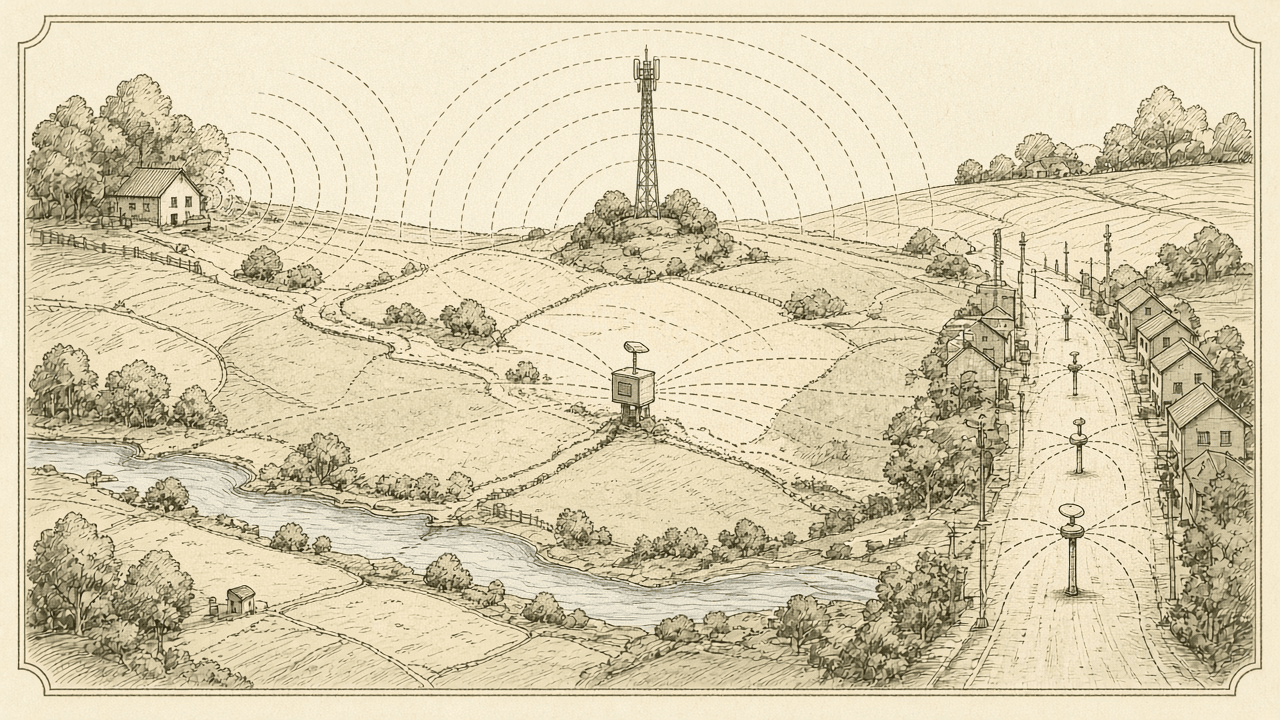
People comparing LoRa vs WiFi for IoT are choosing a radio, and the comparison fails if one is supposed to replace the other. Wi-Fi is a local, higher-capacity network that assumes power and an access point someone can manage. LoRaWAN, built on the LoRa radio, carries small, infrequent messages to gateways rather than through neighboring sensors. A mesh network, explained as a third pattern, means devices relay for one another and can route around a failed neighbor. Cellular is the fourth, for objects that move or sit where you do not own the building network. The job picks the link.
Start with the job, not the logo
Four constraints sort the radios before any brand does. Distance from infrastructure you control, size and frequency of the message, mains power versus a multi-year battery, and whether the device must move.
IoT Analytics, on 28 October 2025, said three families made up nearly 80 percent of connections under its rules: Wi-Fi 32 percent, Bluetooth 24 percent, and cellular 22 percent. Cellular there includes 2G through 5G plus LTE-M and NB-IoT. The firm counts active nodes or gateways, not every sensor behind a gateway, and it excludes phones, computers, and simple one-way tags. Low-power wide-area networks, neighborhood meshes such as Wi-SUN, and satellite sit in the remainder. The shares map deployment, not the next project. Bluetooth’s quarter only has to reach a phone or a hub. It is not an entrant in LoRa vs WiFi.
Wi-Fi: the indoor default, and its edges
Wi-Fi wins indoors when power is available and the payload is large: cameras, displays, gateways, and appliances near an access point. IoT Analytics described three shifts inside that 32 percent. Wi-Fi 6 features such as Target Wake Time let a device sleep. Enterprises are moving to Wi-Fi 6E and Wi-Fi 7. Wi-Fi HaLow, IEEE 802.11ah below 1 GHz, is being tried for longer industrial links, with further shipment growth tied to 2026 onward.
None of that makes Wi-Fi a field network. Coverage is the building, or a careful extension of it. Crowded spectrum, metal, passwords, and someone else’s firewall are the deployment. An installer who does not control the Wi-Fi often cannot use it. Sleep features can cut power and still be wrong for a sensor that speaks briefly for years. Against a low-power wide-area link, ask about payload and energy, not which logo is newer.
Cellular: a network you do not have to build
Cellular fits when the device cannot depend on a site access point: vehicles, freight, and alarms where no local network is trustworthy. It is not one radio. NB-IoT and LTE-M target narrower machine traffic. LTE Cat-1 and Cat-1 bis sit in a middle band. Full 4G and 5G serve cameras, vehicles, and gateways that can afford the power.
That October 2025 article said cellular IoT connections grew 16 percent in 2024. Operators took in 18.4 billion dollars from 4.1 billion cellular IoT connections that year. China Mobile, China Telecom, China Unicom, Vodafone, and AT&T managed 83 percent of them, and China Mobile alone had 44 percent. The same standard is not equally offered, retired, or priced in every country.
IoT Analytics said volume was shifting toward LTE Cat-1 and Cat-1 bis as 2G and 3G shut down, while more revenue sat with 5G uses such as fixed wireless and video telematics. It said NB-IoT was losing momentum in places, and that AT&T shut its NB-IoT data plans in November 2024. “Cellular,” without a generation, a band, and an operator, is not yet a choice. Coverage and the retirement of a generation are the product.
LoRa vs WiFi, without the false tie
LoRa and Wi-Fi answer different jobs. In the LoRa Alliance’s November 2015 overview, LoRa is the radio, a chirp spread-spectrum modulation meant to reach farther while staying frugal. LoRaWAN is the protocol on top. The architecture is a star, not a mesh: devices talk to gateways and do not spend battery forwarding other nodes, which is why the Alliance rejected a sensor mesh. Several gateways may hear one packet and forward it over backhaul the overview listed as cellular, Ethernet, satellite, or Wi-Fi. A network server drops duplicates. A moving device needs no handover, which is why the Alliance pointed to asset tracking.
That overview defined three classes. Class A, required everywhere, opens a downlink only after the device transmits. Class B wakes to a beacon. Class C listens almost continuously, for mains-powered actuators. An October 2025 Alliance session, “LoRaWAN Protocol 101,” still taught those classes as basics. The design has not become Wi-Fi.
Range needs the Alliance’s own qualifier. The 2015 overview said a gateway can cover entire cities or hundreds of square kilometers, and that range depends on the environment and on obstructions. That is a claim about link budget, not a promise for a basement.
On 2 March 2026 the Alliance said more than 125 million LoRaWAN devices were in use at the end of 2025. Next to IoT Analytics’ all-technology total, that is a large low-power base and still a minority of links. Wi-Fi carries bulk data where power and an access point exist. LoRaWAN carries small messages farther, on a battery, via a gateway that still needs backhaul. It is a poor fit for video or for control that cannot wait to receive. Wi-Fi is a poor fit for a lone field sensor.
What a mesh network is, and what it is not
A mesh network is nodes that relay for one another, so a message can hop toward a collector, and traffic can move to another neighbor if one node disappears. The Wi-SUN Alliance’s FAQ uses that idea for outdoor field networks: utility meters, distribution gear, street lights, and similar equipment. Its Field Area Network profile targets those large outdoor systems. The FAQ says FAN 1.1 offers link speeds up to 2.4 megabits per second and a low-power option aimed at devices meant to run ten years or more on a battery. Those are specification claims, not a measurement of every city, and FAN 1.1 does not replace FAN 1.0.
Thread is a building mesh, not a municipal meter mesh. The Thread Group’s fundamentals paper, updated in May 2020, describes an IPv6 network on IEEE 802.15.4 that heals if devices fail, with border routers onto Wi-Fi or Ethernet. It is a network layer. The Group said homes run to hundreds of devices and larger buildings to thousands, and that suitable duty cycles let some nodes last years on small batteries. Matter’s August 2025 rules still assume it: Thread border routers in home network gear should be Thread 1.4 certified and support at least 150 devices. Zigbee is another low-power mesh in IoT Analytics’ personal-area group. It is neither Thread nor LoRaWAN.
Assuming every wireless system relays is the mistake. LoRaWAN refuses that on purpose. Ordinary Wi-Fi is a star around access points; “mesh” on a home router box is a different product. Cellular devices attach to an operator, not to their neighbors. A mesh helps when nodes can hear each other and some may spend energy on others’ packets. It does not help a lone sensor. There is no neighbor to hop through.
How the patterns share a site
Real sites stack the radios. A LoRaWAN gateway’s backhaul, in the 2015 diagram, may be Ethernet, Wi-Fi, cellular, or satellite. A Thread mesh often meets the internet through a border router that is also a Wi-Fi access point. City meters may mesh the last hop and use another link from the collector to the utility. Satellite covers the gap where there is no access point, no cellular plan, and no neighbor, and it is an exception, not a default.
The questions are narrower than “LoRa vs WiFi.” Is the payload a reading, an alert, or an image, and how often must it move? Is power mains, or a cell that has to last years? Who controls the access point, gateway, or SIM when the password or the radio generation changes? If one node fails, do its neighbors matter?
MeshRuby’s writing on the subject stays with that map. A device stays useful when the radio matches the job, including the days the preferred link is missing, and when nobody pretends that one standard quietly retired the others.
Want this in your stores? Request a pilot.