Blog/Note
The Price on the Shelf Edge: Why Label Accuracy Is a Shelf Problem, Not Just a Checkout Problem
Why shelf tags drift from the till price, what 2026 price-accuracy inspections found, how Oman's consumer law treats price display, and where shelf photos help.
November 16, 2026
The Price on the Shelf Edge: Why Label Accuracy Is a Shelf Problem, Not Just a Checkout Problem
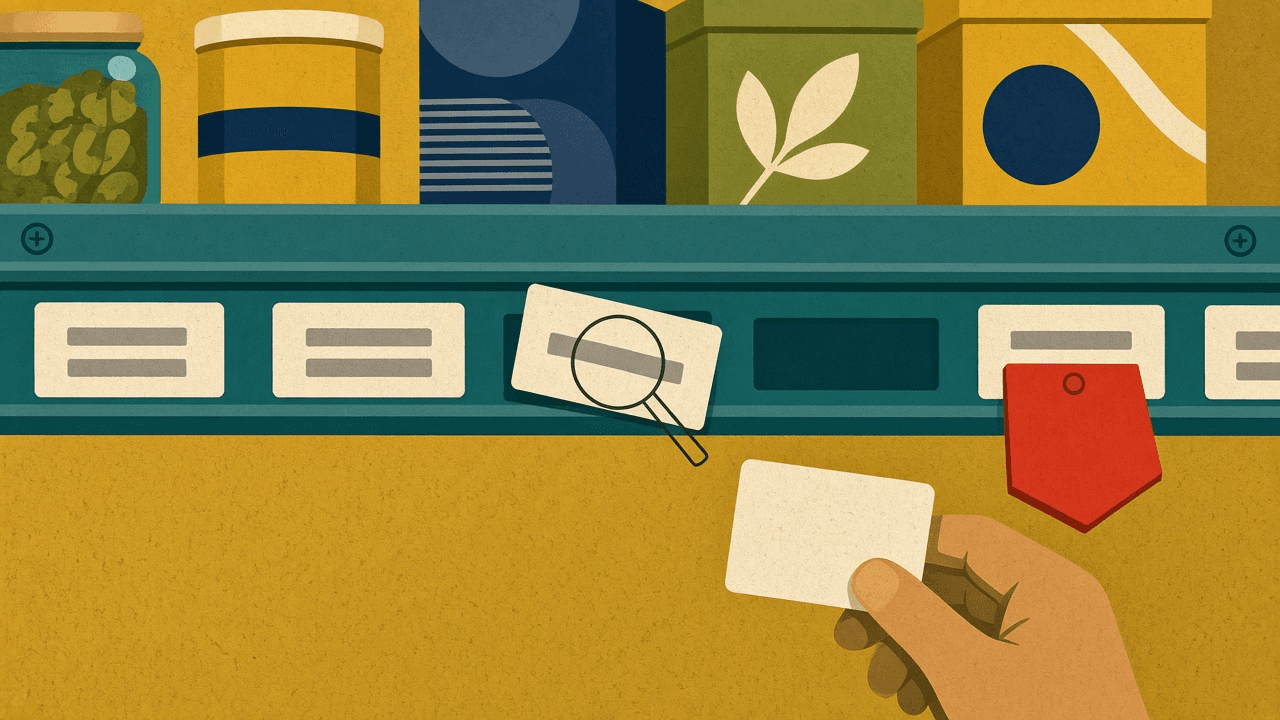
A shopper picks up a carton of eggs because the shelf tag says one price. At the till it rings up higher. To the shopper that is an overcharge. To the store it usually starts as something smaller: a tag that was never swapped after a price change, a promotion that ended but whose sign stayed up, or a label sitting under the wrong product after a restock.
Price accuracy is often discussed as a checkout or scanner issue. In practice, a large share of the problem lives on the shelf edge, where thousands of small paper or electronic labels have to agree with the price file every day.
How inspectors check prices
In the United States, many weights and measures offices use the Examination Procedure for Price Verification (EPPV), developed with NIST and the National Conference on Weights and Measures and published in NIST Handbook 130. Inspectors take a random or stratified sample of items, compare the lowest advertised, posted, or marked price with what rings up at checkout, and record overcharges and undercharges. A store generally passes when at least 98 percent of sampled items are priced correctly.
The procedure is not new. NIST's 1998 "Price Check II" survey, run with the Federal Trade Commission and 37 jurisdictions, checked more than 107,000 items and found about one in 30 mispriced.
What recent inspections are finding
Nearly three decades later, the same kind of error still shows up in inspection reports.
In October 2026, the North Carolina Department of Agriculture and Consumer Services reported fines against 19 stores for price scanning errors in the third quarter. North Carolina flags stores whose overcharge rate exceeds 2 percent, re-inspects them, and fines repeat failures. One follow-up inspection listed in the release found 124 overcharges in a 300-item lot, an error rate of 41.33 percent.
In Ohio, a ConsumerAffairs analysis of government records covered 389 inspections at 101 Kroger stores from 2022 to mid-2026. Inspectors documented 644 incorrect prices, and 474 of them were overcharges. Several of the largest gaps came from digital deals or coupons that failed to apply, such as eggs marked at $3.99 that rang up at $6.19.
The Guardian reported in September 2026 that Circle K and 7-Eleven locations failed large shares of government price-accuracy inspections in several US states between 2023 and 2025. And the New York Attorney General's office said its review of more than 900 inspection reports for Dollar General found price accuracy failures above 2 percent in 43 percent of them between 2021 and 2023.
The Gulf has its own rules
Oman's Consumer Protection Law (Royal Decree 66/2014) and its executive regulations require suppliers to show the price clearly, in Arabic, and the regulations note that in retail the product information must appear on a price tag or near the product. Charging more than the announced or advertised price carries heavier penalties than failing to display a price, according to a Times of Oman interview with a Muscat lawyer. The Consumer Protection Authority has publicly stressed clear price display, and regional inspection reports have listed shelf-versus-till price differences and unhonoured discounts among violations.
Why shelf labels drift
The common failure modes are simple:
Missing labels: a facing has no visible price at all. Stale labels: the system price changed, but the shelf edge was not updated. Expired promotions: the offer ended, the sign did not. Misplaced labels: the tag belongs to a neighbouring product after a reset or restock.
Electronic shelf labels help with the second problem because they update from the price file. They do not, by themselves, prove that the price file is correct, that a promotion applies at the till, or that the label is under the right product.
Where shelf photos fit
This is why some retailers and suppliers now treat price labels as something to check visually, the same way they check gaps and planogram compliance. A regular photo of the shelf edge shows whether a label is present, roughly where it sits relative to the product, and whether promotional signage is still up. Some image-recognition tools go further and read the label text to compare it with the system price.
Two cautions apply. First, any automated comparison is only as good as the reference data; if the price file lags, a correct label can be flagged as wrong. Second, a flag only helps if someone fixes the shelf and the fix is checked afterwards. The most useful moment to look is right after a price change or promotion change, when shelf edges are most likely to be out of sync.
A simple routine for store teams
Check promotional bays on the day an offer starts and the day it ends. Recheck categories the morning after a price file loads. Keep a photo of the shelf edge with each fix, so there is evidence if an inspector or customer asks. Track missing and wrong labels separately; they have different causes.
At MeshRuby, we are building MR.Optic, small cameras that sit on store stands and photograph the shelf several times a day, so store managers can see what the shelf actually looks like without waiting for a visit. If you run stores or distribution in Oman or the wider Gulf, get in touch at meshruby.net.
Sources NIST, Price Verification FAQs: https://www.nist.gov/pml/owm/faqs/price-verification-faqs NIST Handbook 130 (2026), Examination Procedure for Price Verification: https://www.nist.gov/system/files/documents/2025/12/23/2026_HB130-V_Price-Verification-20250925.pdf NIST, Price Check II Shows Scanner Accuracy Has Improved Since 1996 (December 1998): https://www.nist.gov/news-events/news/1998/12/price-check-ii-shows-scanner-accuracy-has-improved-1996 N.C. Department of Agriculture and Consumer Services, 19 stores pay fines for price scanning errors (19 October 2026): https://www.ncagr.gov/news/press-releases/2026/10/19/19-stores-pay-fines-price-scanning-errors ConsumerAffairs, Check your Kroger receipt: Inspectors found hundreds of pricing errors: https://www.consumeraffairs.com/news/check-your-kroger-receipt-inspectors-found-hundreds-of-pricing-errors-092426.html The Guardian, America's biggest convenience-store chains quietly overcharge consumers (24 September 2026): https://www.theguardian.com/us-news/ng-interactive/2026/sep/24/7-eleven-circle-k-convenience-stores-overcharge New York Attorney General, Attorney General James Secures $1.875 Million in Food and Goods from Dollar General for Overcharging Consumers: https://ag.ny.gov/press-release/2026/attorney-general-james-secures-1875-million-food-and-goods-dollar-general Oman Consumer Protection Authority, Consumer Protection Law and Executive Regulations (English): https://cpa.gov.om/Documents/%D9%82%D8%A7%D9%86%D9%88%D9%86%20%D8%AD%D9%85%D8%A7%D9%8A%D8%A9%20%D8%A7%D9%84%D9%85%D8%B3%D8%AA%D9%87%D9%84%D9%83%20%D9%88%D8%A7%D9%84%D9%84%D8%A2%D8%A6%D8%AD%D8%A9%20E2.pdf Times of Oman, How Oman's Consumer Protection Law regulates price display: https://timesofoman.com/article/173264-how-omans-consumer-protection-law-regulates-price-display Oman Observer, CPA warns against unapproved goods price hikes: https://www.omanobserver.om/article/1185520/oman/cpa-warns-against-unapproved-goods-price-hikes The Arabian Stories, Fines totalling OMR 1,300 for violating Oman's Consumer Protection Law (September 2023): https://www.thearabianstories.com/2023/09/13/fines-totalling-omr-1300-for-violating-omans-consumer-protection-law/ VisionX, Computer Vision in Retail: What It Checks on the Shelf: https://visionx.io/blog/computer-vision-retail-shelf-monitoring/ ISTRALLEN, Computer Vision for Price-Tag and Label Verification: https://istrallen.com/blog/computer-vision-price-tag-verification.html
Want this in your stores? Request a pilot.