Blog/Note
What is IoT? The Internet of Things, explained in 2026
What is IoT in 2026? A plain explanation of connected devices, the networks behind them, and why smart is a weak word.
October 3, 2026
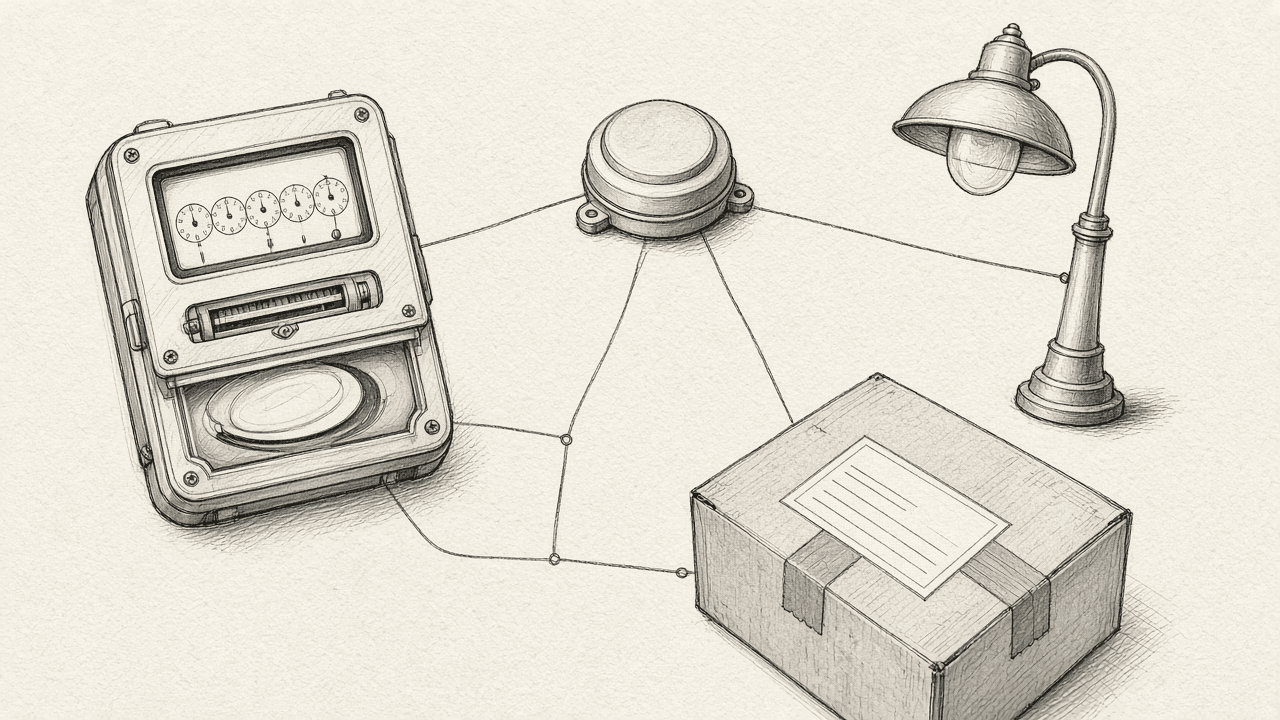
People who type “what is IoT” or “internet of things explained” are trying to separate a category from a sticker. In 2026 the Internet of Things is not one product and not one network. It is infrastructure that lets physical and virtual things communicate, so a device can report a condition, take an action, or do both. That is the direct answer. The rest is why the devices, the radios, and the word smart still get confused, and which public definitions and counts are worth trusting.
A definition that outlasted the marketing
The International Telecommunication Union’s wording has barely moved. Recommendation ITU-T Y.2060, also published as Y.4000, was adopted in 2012. It describes the Internet of Things as a global infrastructure for the information society, enabling advanced services by interconnecting physical and virtual things, using information and communication technologies that are supposed to work together. In November 2025, ITU-T D.1142, a guideline on economic and policy aspects of IoT, restated that definition instead of replacing it.
In that vocabulary a device must be able to communicate. Sensing, actuation, storage, and processing are optional. The thing may be a meter or the software object that stands for it. Identity on a network is the point, not a screen or an app.
That is stricter than casual speech. A laptop is online and is not, in the usual tallies, an IoT device. A sticker that waits for someone to scan it often fails too. A pump that reports pressure and can be stopped fits, and so does an industrial module on a field bus the public never sees.
What the public counts actually count
Anyone quoting a device total should say who drew the line. IoT Analytics, in its State of IoT update of 28 October 2025, said connected devices reached 18.5 billion in 2024, up 12 percent from 2023. From first-half 2025 data it expected 14 percent growth, to 21.1 billion, by the end of 2025. That 2025 figure was about 300 million connections below a forecast the same firm had published in September 2024. It blamed deferred capital spending and softer-than-expected demand in China. The same forecast also sat about 400 million below a projection the firm had made in 2018.
Further out, IoT Analytics estimated 39 billion connected IoT devices in 2030, a compound annual growth rate of 13.2 percent from 2025, and said the total could pass 50 billion by 2035. It expected slower growth after 2030, and no saturation until well after 2035. In that piece, artificial intelligence is a reason to want device data, not a new definition.
Those figures are one firm’s tracking, not a census. The article moves from a 2024 count and a 2025 forecast to 2030 and 2035. It does not publish a finished population for 2026. Stretching a growth rate into a fake total for “this year” is how round numbers become folklore.
The method matters as much as the headline. IoT Analytics counts active nodes, devices, or gateways that concentrate end sensors, not every probe behind them. Hundreds of sensors on one gateway are not hundreds of connections in this series. The tally includes Ethernet and industrial field buses, cellular from 2G through 5G, low-power wide-area networks, personal-area radios such as Bluetooth, Zigbee, and Z-Wave, Wi-Fi, neighborhood meshes such as Wi-SUN, and satellite or other links. It excludes computers, laptops, phones, and consumer tablets, and it excludes simple one-way RFID and NFC. A device that speaks two standards is counted once. Replacements count, so a new meter that retires an old one does not automatically grow the base.
Under that ruler, IoT Analytics said three technologies made up nearly 80 percent of connections: Wi-Fi at 32 percent, Bluetooth at 24 percent, and cellular at 22 percent. The cellular bucket includes LTE-M and NB-IoT as well as ordinary mobile generations. IoT is not “the internet, but for fridges.” Much of it never uses household Wi-Fi. Some of it is a wire in a cabinet. Some of it meets the public internet only when a gateway forwards a summary.
Sensors, actuators, and where the work happens
The U.S. National Institute of Standards and Technology’s Internet of Things Advisory Board, in the report it issued in October 2024, described IoT as devices or distributed systems embedded with sensors and actuators and connected to the internet so they can interact with the physical world. It added a distinction the sales language skips. The data may be processed on the device, on a nearby local server the board called the edge, or off the premises in the cloud.
Drop the adjective and the scenes are ordinary. Homes have locks, lights, and appliances on Wi-Fi or a short-range mesh. Factories still network older machines, which is why field buses remain in serious counts. Cities connect meters, street lights, and alarms to avoid site visits. Freight uses a network the owner does not control, because the asset will not stay in one building. Each case needs a job, a path for the message, and a plan for when that path fails.
Why smart is a bad word
Smart is a marketing compression. It hides the radio, the beneficiary, and the failure.
It hides the radio because a lock on a household access point and a meter on a field mesh do not share a fate. One stops working when the router is replaced and nobody updates a password. The other may keep reporting through neighboring devices. Calling both smart suggests the difference is taste.
It hides who benefits. The system is often smart for a utility, a landlord, or a retailer. The person beside it may get a convenience, or may only be measured. A run of electricity or water readings can sketch when a home is occupied. That is not an argument against meters. It is an argument against reading the label as a favor.
It hides brittleness. A feature that works only while a vendor’s server answers is not the peer of a function that continues when the wide-area link drops. The standards definition never required a particular cloud brand.
Interoperability is the practical version of that complaint. In August 2025 the Connectivity Standards Alliance released Matter 1.4.2, a revision of the household application standard it has published since 2022 so devices can join more than one ecosystem. The release stayed backward compatible. It added setup over Wi-Fi without a Bluetooth radio used only for commissioning, checks meant to stop a fake admin, revocation for bad device certificates, and quieter reporting so devices do not constantly announce unchanged values. For network gear, it said Thread border routers should support at least 150 devices and be certified to Thread 1.4, and that Wi-Fi access points should handle 100 associations at once. Matter does not cover a pipeline. It shows that an app is not a shared language. The Alliance said a 1.5 revision was planned for fall 2025; whether every behavior reached products is a separate question.
Security baselines exist for the same reason. ETSI EN 303 645 version 3.1.3, published in 2024, sets outcome-focused cybersecurity and data-protection provisions for consumer IoT devices and their services. It is not a medal. It exists because connected products reached houses faster than a maintenance model, and a carton that says smart is not an audit.
What to ask instead
If the search was “what is the internet of things,” the durable answer is still institutional. IoT is communications infrastructure for things, with optional sensing and action. The careful public counts exclude phones, are dominated by Wi-Fi, Bluetooth, and cellular, and one widely cited firm stretches them toward 39 billion connections in 2030. The October 2025 downward revision belongs in that story. A bigger forecast is not a sharper definition.
Ask local questions instead. What does this object measure or change? Who operates the network that carries it? What still works after an hour offline, and after a year? Can the software be updated, and can someone report a flaw? Can another system speak to it without the vendor’s app? If the data can identify a person or a household, is collection limited to the job?
MeshRuby publishes notes on connected devices in ordinary places. A definition earns its keep as a test, not as a slogan: a thing with a job, a network chosen for that job, and a failure that was designed rather than discovered later.
Want this in your stores? Request a pilot.